For decades, the digital revolution was a promise of a "global village"—a place where distance would vanish and information would flow freely. By 2026, that promise has been fulfilled, but in a way that is far more complex and pervasive than early pioneers ever imagined. With over 5.6 billion active users—roughly 68% of the global population—social media is no longer a separate "online" world; it is the central nervous system of modern human interaction, commerce, and identity.
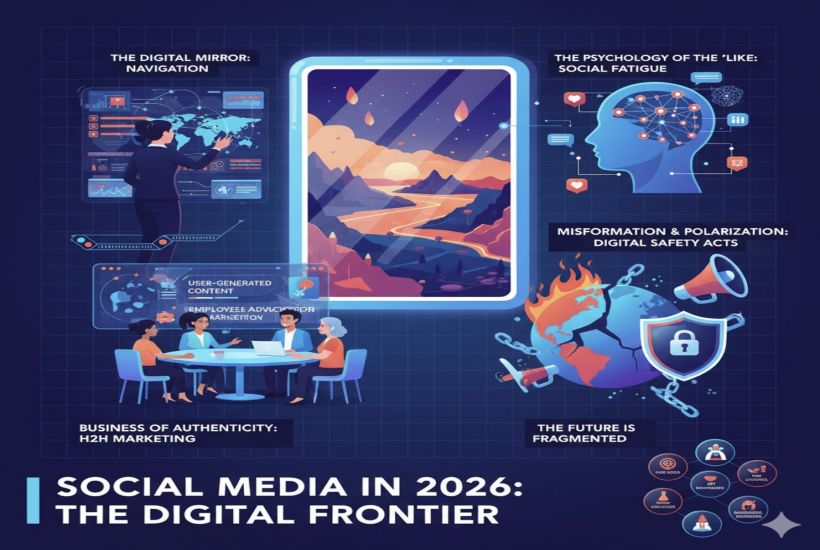
As we navigate this landscape, we find ourselves staring into a digital mirror that reflects both the dizzying heights of human connectivity and the darker shadows of our psychological vulnerabilities.
In its infancy, social media was defined by the "feed"—a linear stream of updates from friends. In 2026, the paradigm has shifted from social networking to algorithmic entertainment and utility. Platforms like TikTok, Instagram, and YouTube have moved away from "who you know" toward "what you love."
Today, a typical user spends roughly 2 hours and 40 minutes daily across nearly seven different platforms. However, the nature of that time has changed. Social media is now the primary search engine for Gen Z and Alpha, with over 60% of product discovery happening on social apps rather than traditional search engines. We don't just "check" social media; we live through it—using it to research careers, book travel, learn new skills, and even access customer service.
Despite the utility, the psychological cost remains a point of intense global debate. The "dopamine loop"—the neurological reward system triggered by likes and shares—is well-documented. By 2026, research has become even more nuanced. A landmark study from the University of Edinburgh recently noted that while moderate use isn't a direct "cause" of mental illness, heavy usage (over two hours a day) correlates with a 3% increase in suicide attempts among teens and a doubling of risk for depression and anxiety.
The "Highlight Reel" effect—where users compare their messy reality to the curated perfection of others—has evolved into what psychologists call "social fatigue." In response, a significant counter-culture has emerged. In 2026, we see a rise in the "Cozy Aesthetic" and "Slow Living" trends—digital movements that prioritize meaningful, low-stimulation content over the frantic "chaos culture" of the early 2020s.
Key Statistic: Approximately 53% of parents now report extreme worry regarding the impact of social media on their children’s self-esteem and mental health, leading to a surge in "digital detox" retreats and app-enforced "zen modes."
The commercial landscape of social media has undergone a "Quality Reset." In 2025 and 2026, the novelty of AI-generated content began to wear thin. While AI tools are now "table stakes" for production, consumers have grown wary of overly polished, synthetic imagery.
The most successful brands in 2026 are those that lean into Human-to-Human (H2H) marketing.
User-Generated Content (UGC): 70% of consumers now demand to see real customer testimonials before buying.
Employee Advocacy: Audiences are 3x more likely to trust a regular employee sharing a "day in the life" than a high-paid celebrity influencer.
Social Commerce: The "Social Funnel" is now the standard; TikTok sparks the demand, Instagram converts the sale, and YouTube provides the long-form validation.
The projected social media ad spend for 2026 is a staggering $317 billion, reflecting the fact that for most businesses, if you aren't social, you don't exist.
The same algorithms that show us the perfect recipe also have the power to silo us into "echo chambers." The 2020s have seen social media become a primary battleground for political discourse, often resulting in increased polarization. The speed at which "viral falsehoods" travel remains a systemic threat to democratic processes.
Furthermore, the rise of cyberbullying has taken on new forms. With the integration of deepfake technology, harassment is no longer just text-based; it involves the manipulation of identity itself. Governments worldwide are finally catching up, with 2026 seeing the introduction of stricter "Digital Safety Acts" aimed at holding platform architects accountable for the mental well-being and privacy of their users.
As we look toward the end of the decade, the trend is toward fragmentation. The era of the "Mega-Platform" that tries to be everything to everyone is fading. Instead, we are seeing the rise of "Side Quests"—smaller, niche communities (on platforms like Discord, Reddit, or specialized professional networks) where users feel safe to express specific facets of their identity without the pressure of a global audience.
The verdict for 2026? Social media is a tool of unparalleled power. It can democratize education, spark global social movements, and provide a lifeline for marginalized voices.